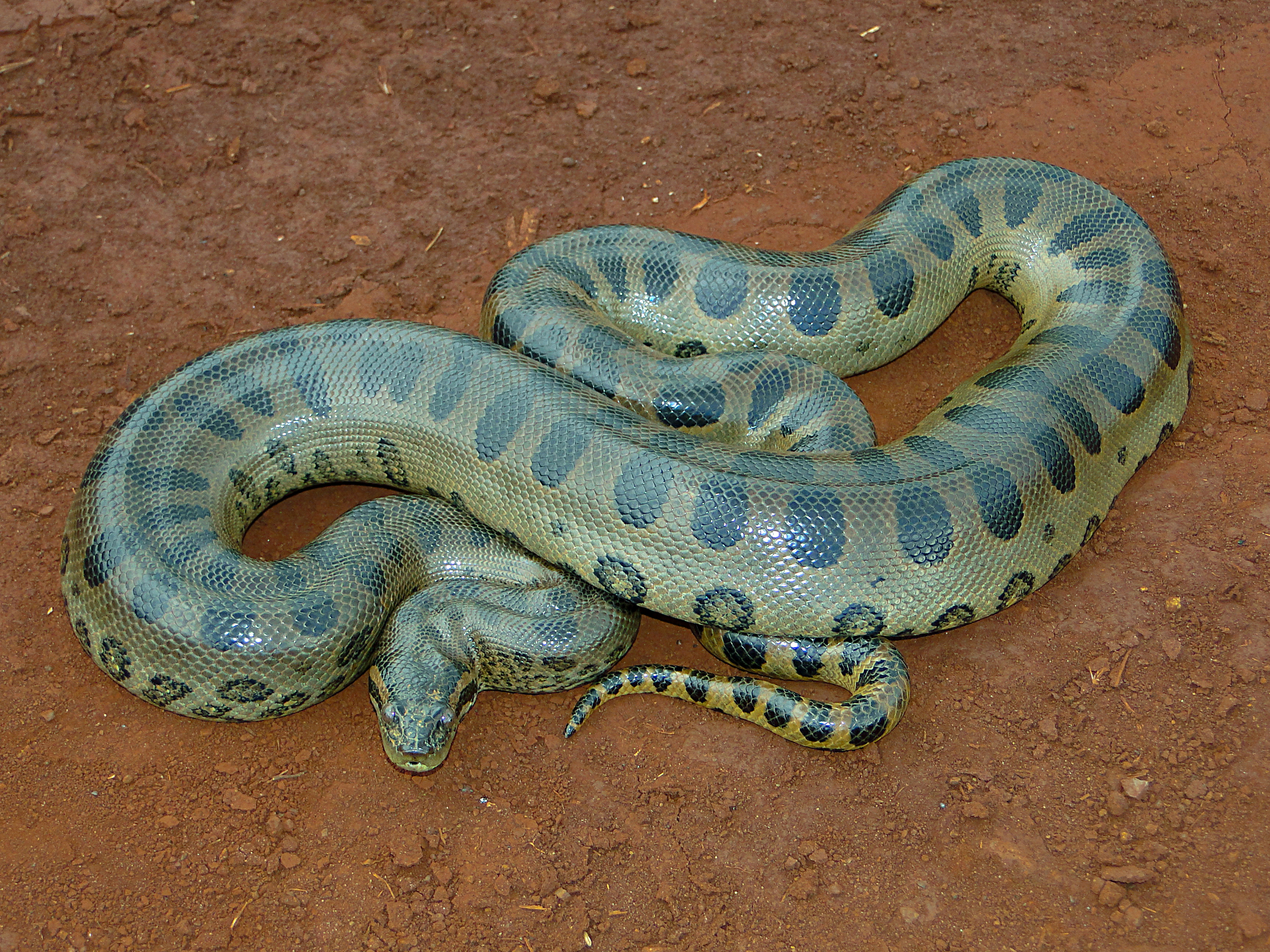
 Yinan Chen · CC0 1.0
Green anaconda
Eunectes murinus
The heaviest snake in the world. The green anaconda ambushes prey in shallow rivers and flooded forest margins, killing by constriction — not venom.
At a glance
How to spot it
Look for a large, motionless shape in shallow river margins at dusk. Anacondas often rest with eyes and nostrils above the waterline.
Threats and conservation
Green anaconda is listed as Least Concern by the IUCN Red List (assessed 2012). You can review the full assessment on the IUCN Red List, the authoritative global database for species conservation status. Detailed information on threats, population trends and active conservation programmes will be added after expert review. For broader Amazon conservation context, see WWF's Amazon programme and the Rainforest Alliance.
Watching responsibly
- Keep a safe distance. Do not approach to get a closer look or photograph.
- Look, listen, wait. Passive observation causes the least disturbance.
- Never feed, bait, call to or touch this animal.
- Follow all local park and reserve rules.
- Go with a qualified, locally-licensed guide whenever possible.
Sources
Conservation status: IUCN Red List Red List. Assessment year: 2012. Full sources will be listed here after expert review. Last checked: 2026-10-13.
Name origin
"Anaconda" is thought to derive from a Tamil or Sinhalese word meaning large snake, carried to South America by European colonisers. Eunectes is Greek for good swimmer; murinus means mouse-coloured in Latin.
Questions about the Green anaconda
What does the Green anaconda eat?
Green anaconda (Eunectes murinus) eats caimans, capybaras, deer, birds. Diet data for Amazon wildlife is documented through databases such as the Encyclopedia of Life, the Animal Diversity Web (University of Michigan) and the Global Biodiversity Information Facility. See the ecology glossary for terms like apex predator, keystone species, and seed dispersal that relate to how diet shapes forest ecosystems.
Where does the Green anaconda live in the Amazon?
The Green anaconda occupies the River of the Amazon rainforest. Explore the layer comparison tool to understand how light, wind and humidity differ between forest floors. The Amazon basin spans nine countries and contains over 10% of all species on Earth, according to the IUCN Red List.
Is the Green anaconda endangered?
The Green anaconda is currently listed as Least Concern by the IUCN Red List (assessed 2012). Verify the current assessment on the IUCN Red List. For context on what these categories mean, see the conservation overview on this site.
When is the Green anaconda active?
The Green anaconda is active during: Night (19–05), Dusk (17–19), Dawn (05–07). Use the sightings tool to explore which species are active at the same time. Activity patterns for Amazon species are studied through long-term ecological monitoring published in journals such as Biotropica.
Where can I read more about Green anaconda conservation?
The conservation page on this site covers IUCN categories, major threats including deforestation and habitat fragmentation, and organisations working in the Amazon. For this species specifically, the IUCN Red List assessment, the WWF Amazon Programme, and the Wildlife Conservation Society are the primary public resources for Amazon species conservation.
Related animals