The guide library
Every animal has a floor.
Pick yours.
Browse species guides for Amazon rainforest animals — mammals like the jaguar, sloth and tapir; birds like the harpy eagle and scarlet macaw; reptiles and amphibians like the anaconda and poison dart frog; fish like the piranha; and insects. Filter by forest layer, animal group, or search by name.
Search the guides
By kind of animal

Jaguar: the cat that rules the riverbank
How the largest cat in the Americas hunts, where it lives, why it swims, and what threatens it today.
Read the guideAll guides
Jaguar
Panthera onca
The largest cat in the Americas and the top predator of the Amazon. It is a strong swimmer and often hunts along the water, including caiman and turtles.

Harpy eagle
Harpia harpyja
One of the world's largest and most powerful eagles. Its huge talons — larger than a grizzly bear's claws — can snatch monkeys from the canopy.
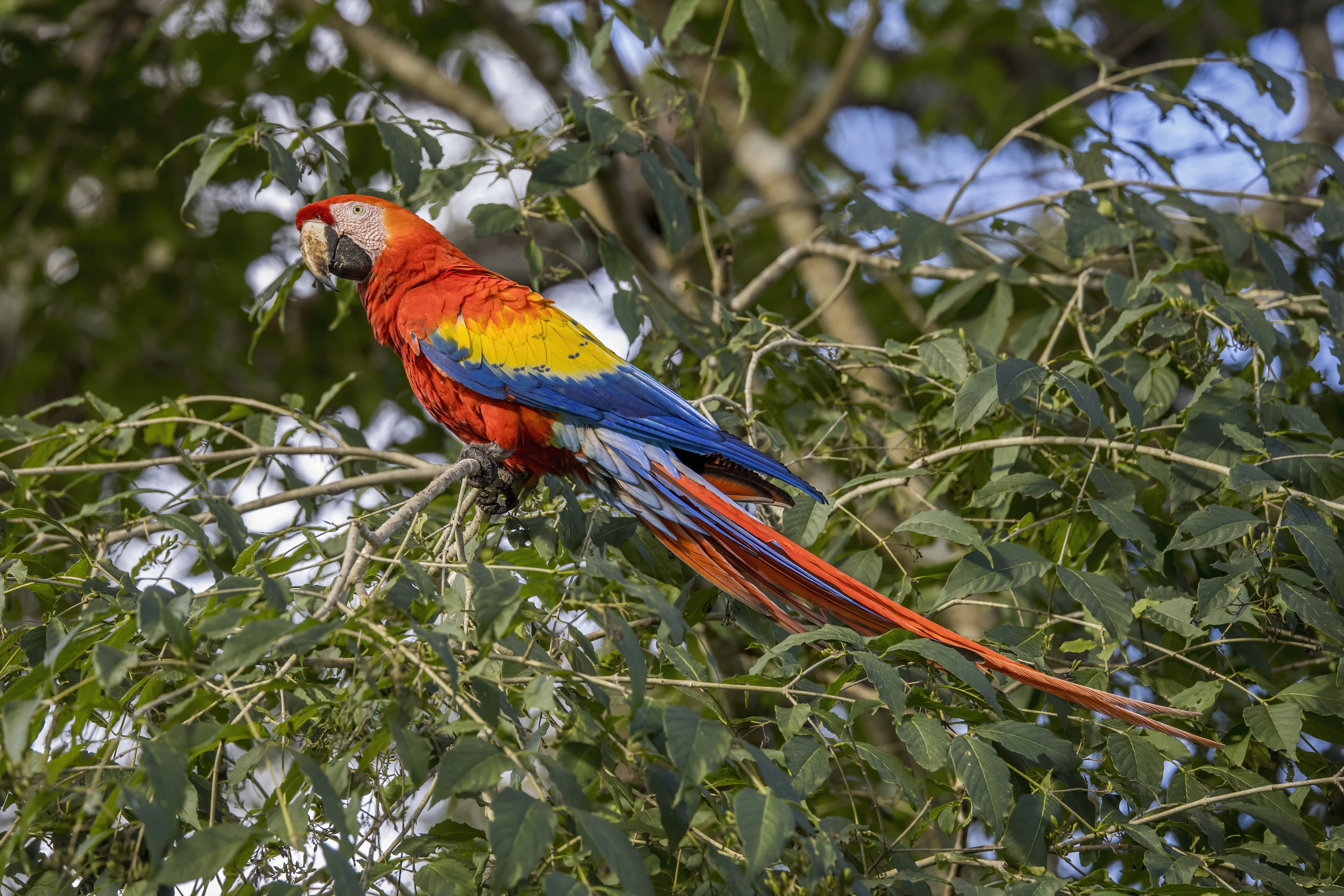
Scarlet macaw
Ara macao
Brilliantly coloured and highly social, scarlet macaws fly in noisy pairs or flocks above the canopy. They visit clay licks to detoxify unripe seeds.

Brown-throated sloth
Bradypus variegatus
The most common sloth in the Amazon, spending up to 20 hours a day in the canopy. Its slow metabolism means it descends to the ground only once a week.

Poison dart frog
Dendrobates tinctorius
Their vivid colours warn predators of potent skin toxins. In the wild, the toxins come from a diet of specific mites and ants — captive frogs lose toxicity.

Amazon river dolphin
Inia geoffrensis
The largest river dolphin in the world, and the only one that turns pink with age. It can rotate its head 180° to navigate through flooded forest roots.
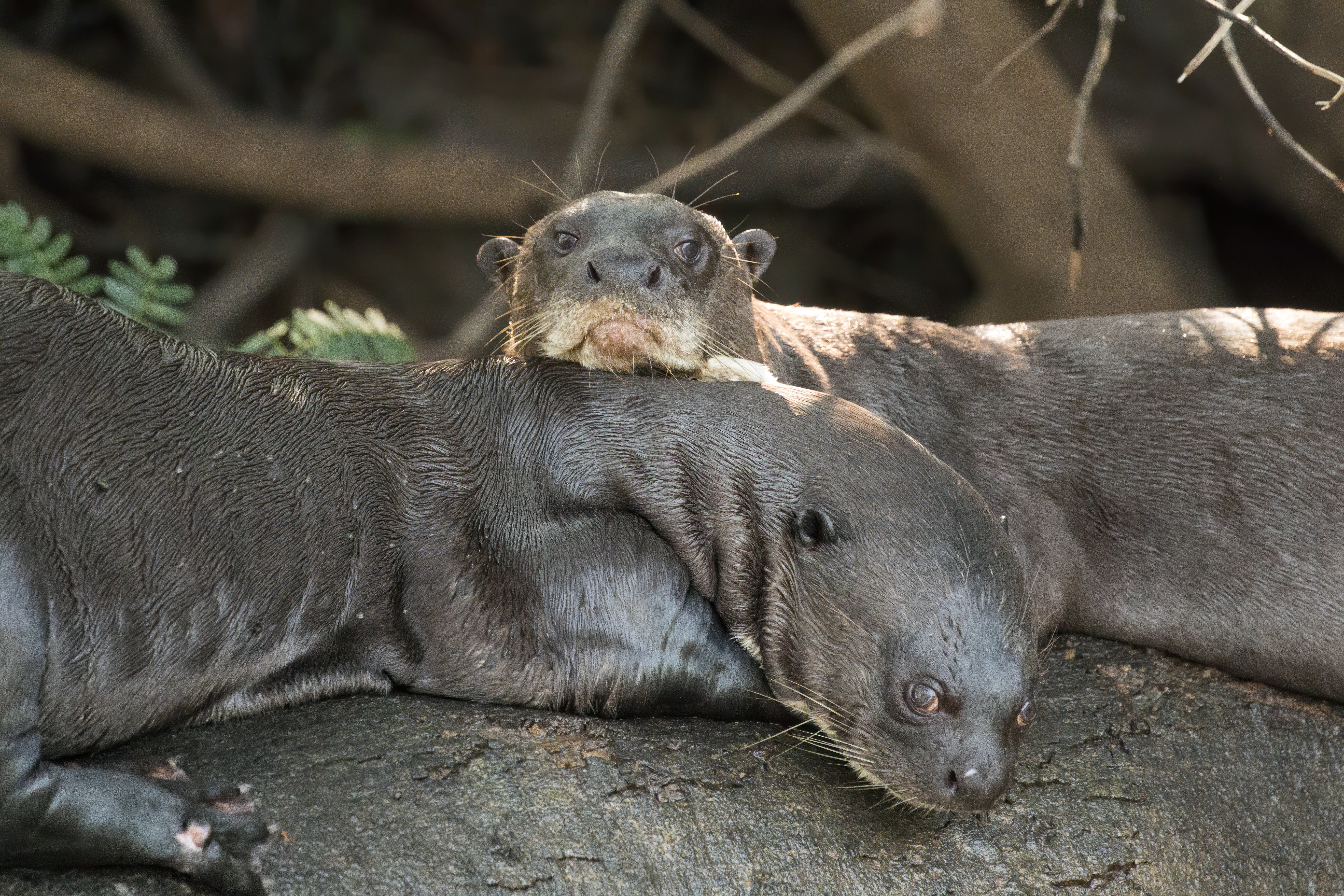
Giant otter
Pteronura brasiliensis
The world's largest otter, living in noisy family groups. They are highly territorial and will confront black caimans to defend their fishing territory.

Black caiman
Melanosuchus niger
The largest predator in the Amazon ecosystem. After near-extinction from hunting, populations have partially recovered since legal protection in the 1970s.

South American tapir
Tapirus terrestris
The largest land mammal in South America, the tapir is a keystone seed disperser. It swims well and often enters water to escape predators and cool down.

Toco toucan
Ramphastos toco
The largest toucan species, instantly recognisable by its enormous orange-yellow bill. The bill is surprisingly light — made of a honeycomb of keratin — and serves as a thermoregulator, radiating body heat through a network of blood vessels. It also helps the bird reach fruit on thin branches that cannot support its weight.

Howler monkeys
Genus Alouatta
The loudest land animals, heard up to 5 km away. Their enlarged hyoid bone amplifies a deep, resonant roar used to defend territory without physical confrontation. Howler monkeys are folivores — they eat mostly leaves, which provide little energy, so they spend up to 80% of the day resting and move slowly through the canopy.

Emerald tree boa
Corallus caninus
A striking green, non-venomous constrictor that hunts from a distinctive coiled posture draped over horizontal branches. It is a nocturnal ambush predator with heat-sensing pits along its lips that detect warm-blooded prey in total darkness. Juveniles are bright red or orange, changing to green as they mature.

Blue morpho butterfly
Genus Morpho
One of the most recognisable insects in the tropics, the blue morpho's iridescent wings contain no blue pigment — the colour comes from microscopic scales that reflect light through structural interference. The underside is dull brown with eyespots, making the butterfly appear to vanish each time it closes its wings. Adults feed on rotting fruit and tree sap on the forest floor.

Leafcutter ant
Atta cephalotes
Leafcutter ants are among the world's most sophisticated farmers. They cut leaves not to eat, but to feed underground fungus gardens — their only food source.

Ocelot
Leopardus pardalis
The most widespread small wild cat in the Americas. The ocelot hunts nocturnally along the forest floor; its patterned coat provides camouflage in dappled light.
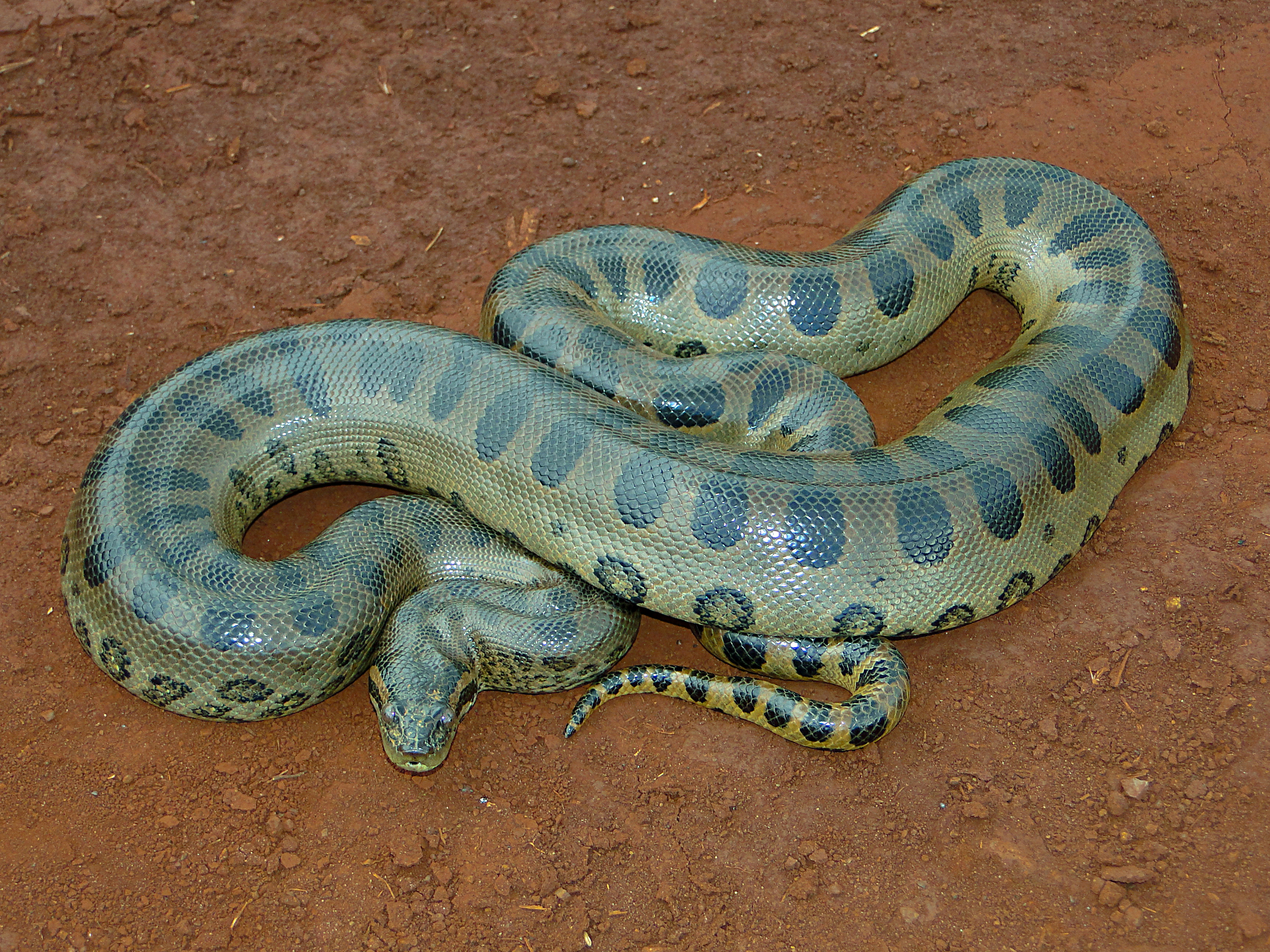
Green anaconda
Eunectes murinus
The heaviest snake in the world. The green anaconda ambushes prey in shallow rivers and flooded forest margins, killing by constriction — not venom.
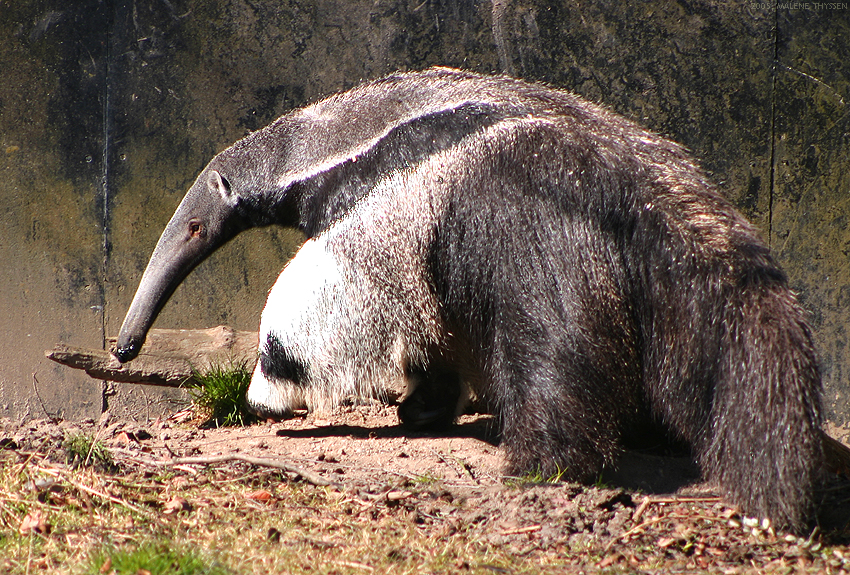
Giant anteater
Myrmecophaga tridactyla
The largest anteater species. The giant anteater has no teeth and uses a 60cm sticky tongue to extract up to 35,000 ants and termites per day from mounds.

Capybara
Hydrochoerus hydrochaeris
The world's largest rodent. Capybaras live in family groups along Amazon riverbanks and are a key prey species for jaguars, anacondas and caimans.
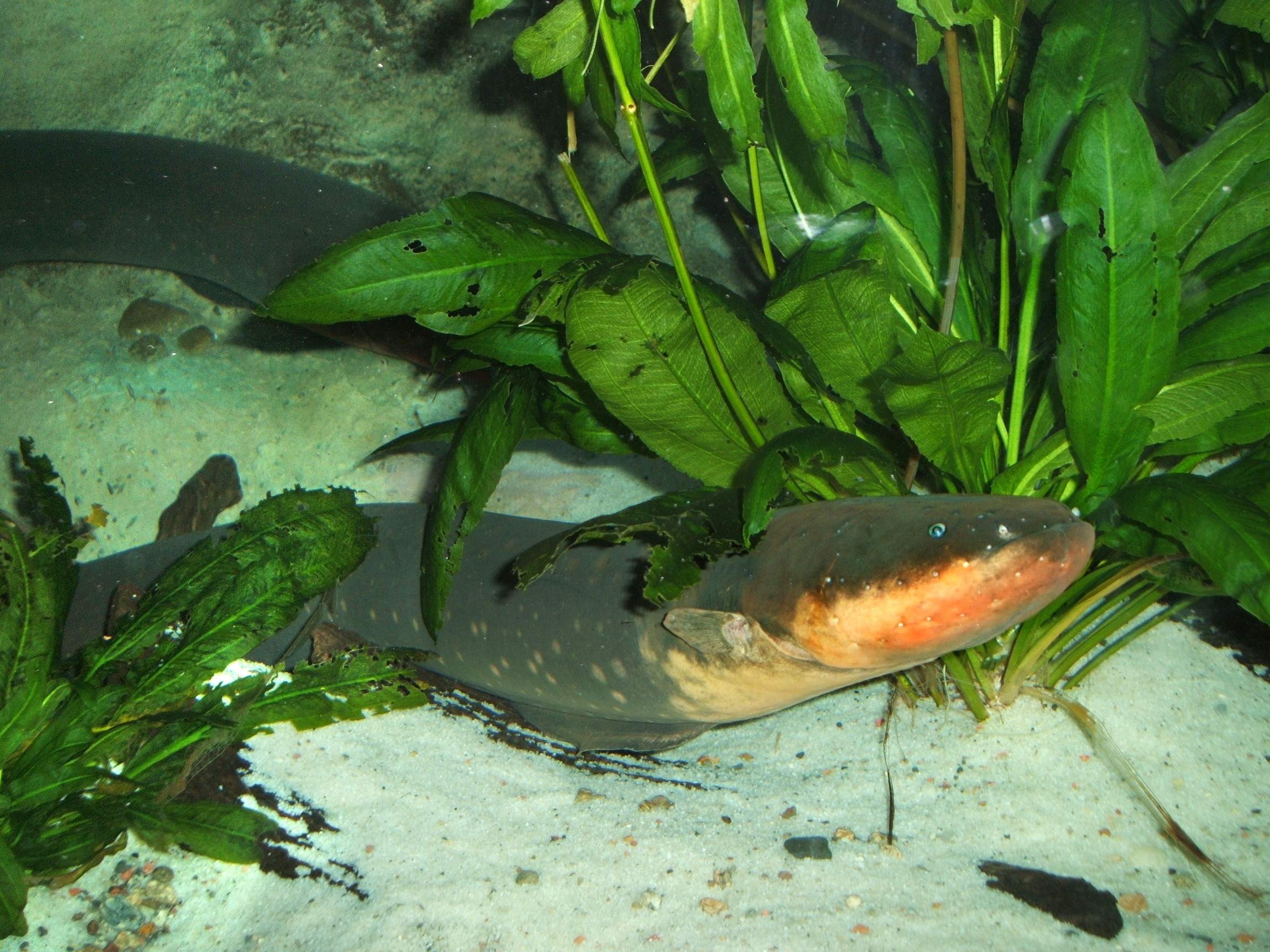
Electric eel
Electrophorus electricus
Not a true eel but a knifefish. The electric eel generates up to 860 volts to stun prey and navigate the murky Amazon riverbed in near-zero visibility.

Common woolly monkey
Lagothrix lagothricha
A large, slow-reproducing canopy primate with a prehensile tail. The woolly monkey is hunted heavily and ranks among the most vulnerable Amazon primates.

Red-bellied piranha
Pygocentrus nattereri
The most studied piranha. Red-bellied piranhas are mainly scavengers and fruit-eaters; pack-hunting of live prey is far rarer than their fearsome reputation implies.

Spectacled caiman
Caiman crocodilus
The most abundant crocodilian in the Americas. The spectacled caiman takes its name from a bony ridge between the eyes that resembles spectacle frames.

Collared peccary
Pecari tajacu
A pig-like hoofed mammal living in tight herds across the Amazon forest floor. Peccaries are important seed dispersers and a key prey item for jaguars.

Arapaima
Arapaima gigas
One of the largest freshwater fish on Earth, reaching 3m and 200kg. The arapaima breathes air and must surface every 5–15 minutes — audible before it is visible.

White-lipped peccary
Tayassu pecari
A large, highly social forest-floor mammal living in herds of 50–300. White-lipped peccaries are keystone seed dispersers and among the most important jaguar prey.

Tayra
Eira barbara
A long-bodied mustelid that moves through all five forest layers in pursuit of fruit, small mammals and birds. Tayras cache food and revisit caches days later.

Amazon glass frog
Hyalinobatrachium sp.
A tree frog whose organs are visible through translucent belly skin. Glass frogs nest on leaves above Amazon streams; tadpoles drop into the water when eggs hatch.

Hoatzin
Opisthocomus hoazin
A prehistoric-looking canopy bird unique to Amazon riverbanks. Hoatzin chicks have clawed wings for gripping branches — a feature lost in all other modern birds.
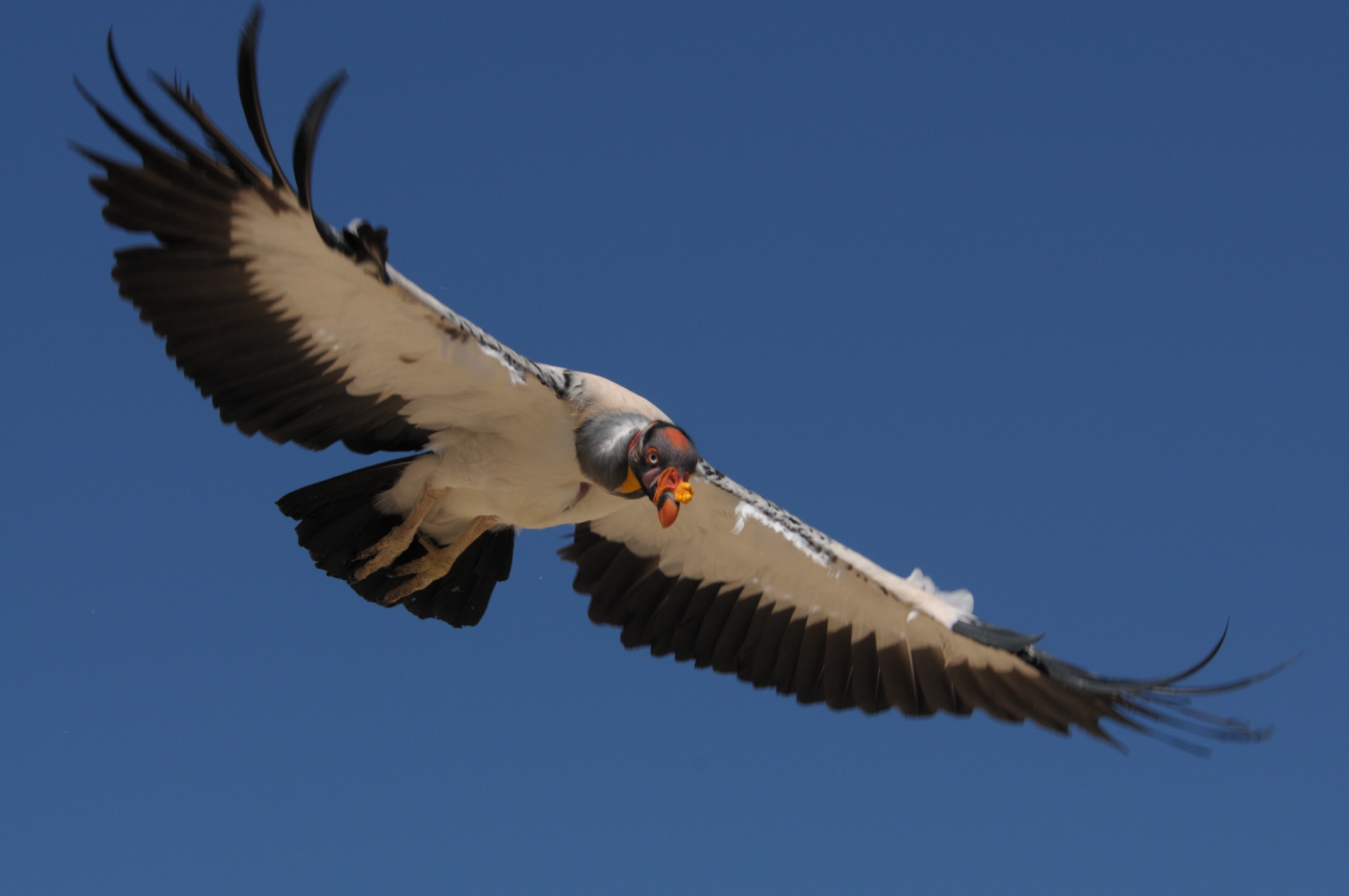
King vulture
Sarcoramphus papa
The largest New World vulture in the Amazon. The king vulture soars over the emergent layer on thermal updrafts, locating carcasses invisible beneath the canopy.

Bullet ant
Paraponera clavata
Named for a sting ranked the most painful of any insect. Bullet ants forage alone on trunks and return to underground forest-floor colonies each night.

Amazonian manatee
Trichechus inunguis
The only fully freshwater manatee. The Amazonian manatee grazes on floating vegetation in slow rivers and oxbow lakes, surfacing every few minutes to breathe.
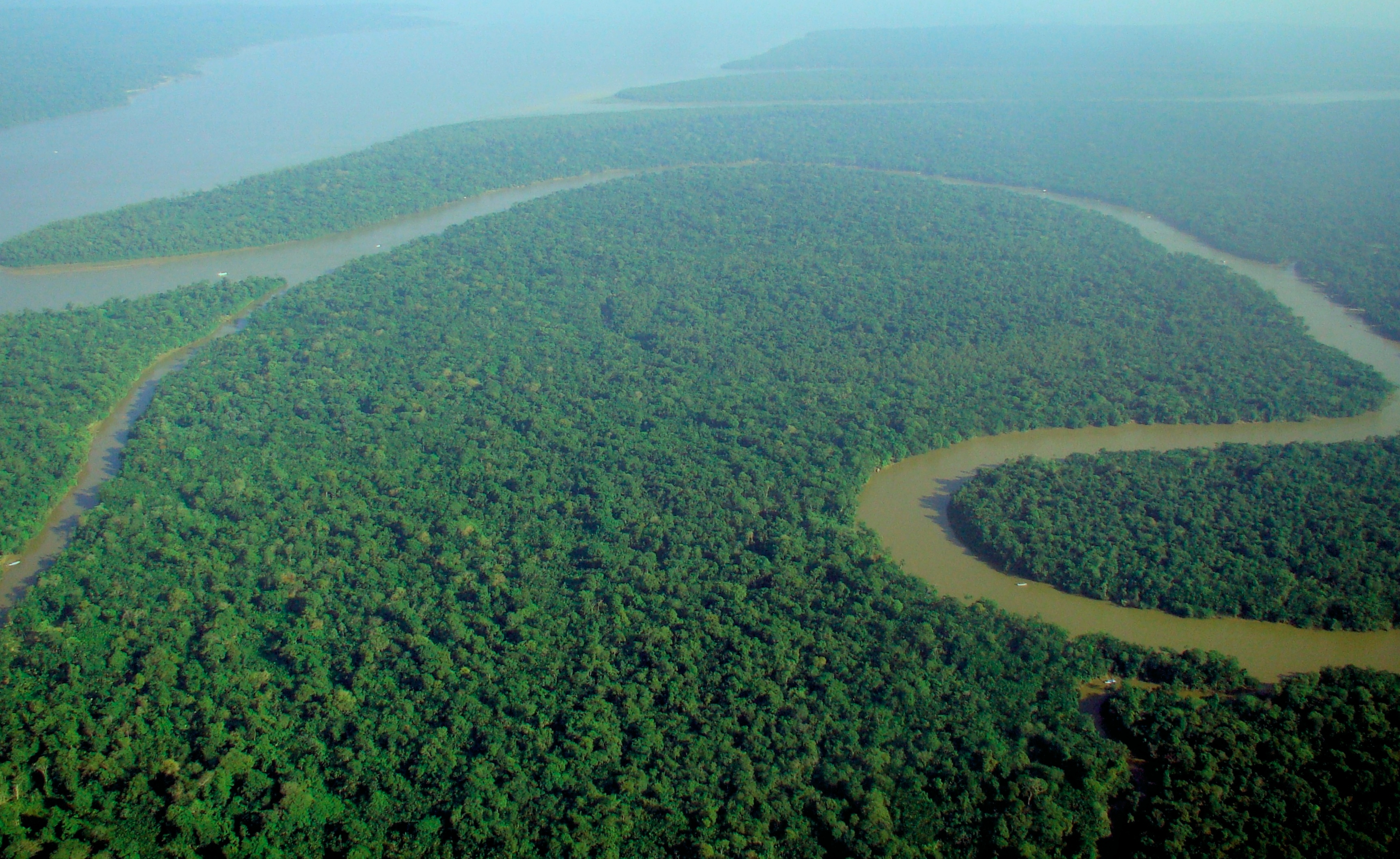
How the forest layers work
Habitat guide
Light, height and humidity: why each layer holds different animals.

Puma
Puma concolor
The most widely distributed large cat in the Americas, ranging from Canada to Patagonia. In the Amazon the puma is second apex predator after the jaguar, and the two species co-exist by partitioning prey size and activity hours.
Spectacled owl
Pulsatrix perspicillata
The largest owl in the Amazon rainforest and one of the most striking — a dark brown upper body contrasts sharply with a pale yellow-white breast, framed by bold white "spectacles" around the eyes. A strictly nocturnal ambush predator.
Giant river turtle
Podocnemis expansa
South America's largest river turtle and one of the largest freshwater turtles in the world. Females aggregate by the thousands on Amazon sandbars each October to lay eggs — one of the most spectacular mass nesting events in the world.
Red brocket deer
Mazama americana
The most widespread deer in the Amazon, the red brocket moves singly or in pairs through dense forest understorey and forest floor, following fruiting cycles and seasonal flood pulses. Hunted heavily across its range, it persists in protected forest but is locally extirpated in heavily hunted landscapes.
Horned screamer
Anhima cornuta
One of the strangest-looking birds in the Amazon, the horned screamer is a goose-sized waterbird with a unique 15cm bony horn projecting from its forehead, two sharp wing spurs, and an astonishing carrying call audible over three kilometres. Despite its bulk it soars on thermals above floodplain lakes and is an excellent swimmer.
Margay
Leopardus wiedii
The most arboreal of the Amazon's small cats, the margay is built for three-dimensional life in the canopy. Its ankles rotate 180° — allowing it to descend trees head-first and hang by a single hind foot — and its large eyes and sensitive whiskers are adapted for hunting in near-darkness among branches. It is strictly solitary and almost never seen on the ground.
Hercules moth
Coscinocera hercules
One of the largest moths in the world by wing area, the Hercules moth has a wingspan reaching 27cm. Adults emerge from their silk cocoon, mate, lay eggs, and die within a week — they have no functional mouthparts and never feed as adults. The caterpillars are bright green and reach 12cm before pupating in a heavy silk cocoon attached to a branch.
Amazon kingfisher
Chloroceryle amazona
The most commonly encountered kingfisher along large Amazon rivers, the Amazon kingfisher perches on overhanging branches above clear water, scanning for fish. It is bright green above with a chestnut breast band in males. Pairs are territorial along river corridors and announce themselves with a loud, rattling call. A reliable indicator of good river water quality.
Black spider monkey
Ateles paniscus
The largest monkey in the Amazon, the black spider monkey spends almost its entire life in the high canopy and emergent layer, travelling in loose fission-fusion groups through home ranges of up to 2.5 km². Its prehensile tail functions as a fifth limb, allowing arm-swinging (brachiation) travel through gaps no other primate can bridge. Highly sensitive to hunting and habitat loss, it is absent from forests that have experienced even moderate human pressure.
Sun bittern
Eurypyga helias
One of the most visually extraordinary birds in the Amazon, the sun bittern reveals hidden wings of orange, chestnut and black — like two painted eyes — when threatened or displaying. At rest it appears a drab grey-brown streaked bird walking slowly along shaded stream edges. It is the sole member of its family (Eurypygidae) and has no close relatives among living birds.
Common potoo
Nyctibius griseus
A master of camouflage, the common potoo roosts motionless on broken branch stubs during the day, holding its body rigid and vertical with eyes slitted — appearing indistinguishable from dead wood. At night it becomes a surprisingly agile aerial hunter, launching from a perch to catch large moths and beetles and returning to the same roost. Its far-carrying mournful wail is one of the defining sounds of Amazonian nights.
Cuvier's dwarf caiman
Paleosuchus palpebrosus
The smallest crocodilian in the world, Cuvier's dwarf caiman inhabits fast-moving blackwater streams and rocky rivers in the Amazon — habitats avoided by the larger spectacled and black caimans. Unlike other caimans, it has a heavily ossified hide that provides body armour rather than thermal regulation, and it nests in mounds of vegetation rather than sandy banks. Its short, upturned snout gives it a dog-like face distinct from other Amazon crocodilians.
Amazon tree boa
Corallus hortulanus
One of the most variably coloured snakes in the world, the Amazon tree boa occurs in almost every combination of brown, orange, yellow, red, grey and black — individuals of the same species can look entirely different. This colour diversity is not mimicry but reflects genuine genetic variation. Strictly arboreal and nocturnal, it coils on a branch with its head suspended, using heat-sensitive pits along its jaw to detect warm-blooded prey in complete darkness.
White-fronted capuchin
Cebus unicolor
Capuchin monkeys are the most cognitively flexible primates in the Amazon, using stones to crack palm nuts, stripping bark to find beetle larvae, and learning new foraging techniques from group members across generations. White-fronted capuchins move in noisy bands of 8–20 through the mid-canopy, exploiting a wide range of food sources and often following army ant raids to catch the insects and lizards the ants flush out.
Ringed kingfisher
Megaceryle torquata
The largest kingfisher in the Western Hemisphere, the ringed kingfisher is a conspicuous presence on large Amazon rivers, perching on prominent branches above open water and launching steep, splashing dives for fish. The male has a chestnut breast band; the female has blue-grey above with a chestnut belly. Pairs are strongly territorial along river reaches, and their loud, rattling call carries far across open water.
Black hawk-eagle
Spizaetus tyrannus
A powerful, fast-flying raptor of the Amazon canopy, the black hawk-eagle is all black with a barred belly and a prominent erectile crest. Less massive than the harpy eagle, it compensates with speed and manoeuvrability in dense forest, hunting medium-sized birds and mammals through the canopy interior. It announces itself with a loud, high-pitched whistle that carries long distances through the forest.
Red-and-green macaw
Ara chloropterus
The largest macaw by size in the Amazon and one of the most spectacular birds in the world, the red-and-green macaw is crimson from head to mid-back with vivid green and blue wing panels. It is longer-tailed and heavier-bodied than the scarlet macaw and has a distinctive bare red facial patch crossed with lines of tiny green feathers. Large flocks gather daily at clay licks alongside scarlet macaws and other parrots to consume mineral-rich soil.
Proboscis bat
Rhynchonycteris naso
The proboscis bat is a tiny, distinctive bat that roosts in small groups of 3–12 individuals on exposed surfaces — driftwood, tree trunks, exposed rock faces — directly above or beside Amazon river water. Its pointed nose and cryptic grey-brown bark-pattern fur make roosting groups almost invisible against wood. At dusk the group launches together to hunt insects in low, fast flight just above the water surface.
Pygmy marmoset
Cebuella pygmaea
The smallest monkey in the world and one of the most specialised, the pygmy marmoset is a gum-feeding specialist that carves sap-exuding holes into tree bark with its elongated lower incisors. A family group of 2–9 maintains a territory of 0.1–0.4 ha around a handful of "gum trees" that it manages and defends. Quick, darting movements and cryptic brown-and-gold fur make it one of the hardest primates to spot in the wild.
Mata mata turtle
Chelus fimbriata
One of the most bizarre-looking vertebrates in the Amazon, the mata mata has a flattened, rough-edged shell resembling dead leaves and bark, a long tubular snout acting as a snorkel, and fringed flaps of skin along its neck that detect water movements from approaching fish. It hunts entirely by ambush: lying motionless on the riverbed for hours until a fish passes within range, then opening its mouth in a rapid vacuum strike that sucks the prey in before it can react.
Andean cock-of-the-rock
Rupicola peruvianus
The national bird of Peru, the Andean cock-of-the-rock is one of the most visually spectacular birds in the western Amazon. Males are brilliant orange-red with a large fan-shaped disc crest covering the bill; females are dull brown. Males gather at traditional display arenas (leks) where they perform elaborate bowing, wing-flicking and call displays to compete for female attention — one of the most dramatic courtship spectacles in the bird world.
Giant armadillo
Priodontes maximus
The largest armadillo in the world and one of the most rarely observed mammals in the Amazon, the giant armadillo digs burrows up to 5 metres deep to access termite mound cores and constructs a new sleeping burrow almost every night. Its presence at a site is usually only revealed by large conical digging pits at termite mounds. A single individual can excavate a termite mound in minutes, exposing the interior galleries with its massive hooked foreclaws.
Amazon river stingray
Potamotrygon motoro
The most widely distributed freshwater stingray in the Amazon and one of the few cartilaginous fish fully adapted to freshwater, the Amazon river stingray lies buried in sandy or muddy substrate during the day, partially covered with sediment. It has a venomous serrated spine at the base of the tail used defensively against predators and humans who accidentally step on it. The species is viviparous — live-bearing rather than egg-laying — an unusual trait among fishes.
Bare-faced ibis
Phimosus infuscatus
A stocky, dark ibis common along Amazon riverbanks, floodplain margins and várzea grasslands, the bare-faced ibis is immediately identified by the patch of bare red facial skin encircling the eye. It forages in loose groups along muddy riverbanks and wet forest clearings, using its decurved bill to probe for invertebrates in soft substrate. Though less spectacular than the scarlet ibis, it is one of the most reliably observed waterbirds on Amazon river journeys.
Amazon milk frog
Trachycephalus resinifictrix
A large, robust tree frog with bold grey-and-brown banding, the Amazon milk frog gets its name from the thick, milky white secretion it produces when threatened — a toxin that deters most predators and irritates mucous membranes on contact. It breeds exclusively in water-filled tree hollows high in the Amazon canopy, where tadpoles hatch and develop without any connection to ground water. The species is also popular in captive husbandry, making it one of the more frequently photographed Amazon frogs.
Razor-billed curassow
Mitu tuberosum
A large, turkey-sized bird of the Amazon forest floor, the razor-billed curassow is all black with a distinctive bright red bill topped by a laterally flattened blade-like casque that gives it its common name. It walks slowly through the forest floor in pairs or small family groups, eating fallen fruit, seeds and invertebrates. Like all curassows, it is heavily hunted wherever humans are present and quickly disappears from accessible forest — it functions as an indicator of hunting pressure.
Capped heron
Pilherodius pileatus
One of the most elegant herons in the Amazon, the capped heron has a pure white body, creamy-buff neck, black cap and bright blue facial skin — an unusual combination that makes it unmistakable. It is a solitary, quiet hunter of shaded forest streams and small pools, moving at a characteristically slow, deliberate pace. Unlike most herons it rarely occurs on large open rivers, preferring small, sheltered water bodies within forest interior.
Amazon giant centipede
Scolopendra gigantea
The largest centipede in the world, the Amazon giant centipede is a powerful nocturnal predator that can kill and consume prey many times larger than typical invertebrates — including small bats caught from cave roosts. It injects venom through a pair of modified front legs (forcipules) that can cause intense pain, tissue necrosis and systemic symptoms in humans. Despite its fearsome reputation it is a vital component of the forest floor food web, controlling populations of insects, frogs and small rodents.
Nothing on this trail yet.
Not sure where to start?
Answer three questions and we mark a personal trail through the guides.
Plan your expeditionMissing an animal?
The library grows page by page. Tell us which guide you want next.
Request a guideAbout the guide library
Frequently asked.
How are the guides organised?
Guides are organised by forest layer — the vertical zone of the Amazon where each species primarily lives. You can also filter by animal group (mammals, birds, reptiles and amphibians, fish, insects) or search by name. Each guide follows the same structure: at-a-glance facts, how to spot it, conservation status and sources.
Are the guides accurate?
All current guides are marked as drafts pending expert review. Facts are sourced from the IUCN Red List, the Encyclopedia of Life, the Animal Diversity Web and peer-reviewed field research. Taxonomy is verified against the Catalogue of Life. Sources are listed on each guide page.
Can I request a guide for a species not yet covered?
Yes. The library grows continuously. Use the contact page to request a specific species or habitat guide. We prioritise by the number of requests received and the availability of quality source material.
What does the conservation status badge mean?
The status badge on each guide shows the species' current IUCN Red List category: LC (Least Concern), NT (Near Threatened), VU (Vulnerable), EN (Endangered) or CR (Critically Endangered). The assessment body and year are also shown. You can read a full explanation of each category on the IUCN Red List introduction page.
Do you have a guide for the jaguar?
Yes. The jaguar (Panthera onca) is the largest cat in the Americas and one of the flagship species on this site. The guide covers how jaguars hunt, why they swim, their forest-floor and riverbank habitat, and their Near Threatened conservation status. Read it at animalstheguide.com/guides/jaguar.
Which rainforest animals are covered in the guides?
The guide library currently covers Amazon rainforest animals across five animal groups. Mammals include the jaguar, puma, ocelot, tapir, giant anteater, capybara, sloth, woolly monkey, howler monkey, collared peccary, giant otter, Amazon river dolphin and Amazon manatee. Birds include the harpy eagle, scarlet macaw, toco toucan, king vulture and hoatzin. Reptiles and amphibians include the green anaconda, emerald tree boa, black caiman, spectacled caiman, poison dart frog and glass frog. Fish include the piranha, arapaima and electric eel. Insects include leafcutter ants, bullet ants and the blue morpho butterfly.
Is there a guide for the toucan?
Yes. The toco toucan (Ramphastos toco) guide explains the function of its oversized bill, its canopy habitat, nesting habits and diet. The toco toucan is the largest toucan species and one of the most recognisable birds in South America. Read the guide at animalstheguide.com/guides/toco-toucan.
Is there a guide for the sloth?
Yes. The brown-throated sloth (Bradypus variegatus) guide covers its extreme slow metabolism, upside-down canopy life, algae-covered fur coat and why its slowness is actually a survival strategy. Sloths are one of the most searched Amazon animals. Read the guide at animalstheguide.com/guides/brown-throated-sloth.